


Vector Data
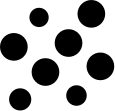
Geospatial data represented as points, lines, and polygons. Each feature has a geometry and associated attributes. Used for representing discrete features like roads, buildings, administrative boundaries, and field parcels. Common formats include GeoJSON, Shapefile, and GeoPackage.
Overview
Vector data represents geographic features as discrete geometric objects — points, lines, and polygons — each associated with attribute information stored in a database table. A city might be represented as a point with attributes for name, population, and country. A road network as lines with attributes for road class, speed limit, and surface type. A land parcel as a polygon with attributes for owner, area, and zoning category. This object-based representation makes vector data ideal for discrete, well-defined features that have clear boundaries.
How It Works
Vector geometries are defined by coordinate vertices. A point has a single coordinate pair (x, y). A line (linestring) is an ordered sequence of vertices. A polygon is a closed ring of vertices, optionally containing interior rings (holes). Multi-geometries group multiple primitives of the same type. Each feature's geometry is linked to a row in an attribute table, creating a one-to-one relationship between spatial and non-spatial data.
Common formats include GeoJSON (web-native, RFC 7946), Shapefile (legacy, widely supported), GeoPackage (OGC standard, SQLite-based), GeoParquet (cloud-native, columnar), and FlatGeobuf (optimized for streaming). Spatial databases like PostGIS store vector data with spatial indexing (R-trees) for fast query performance. Spatial operations include buffering, intersection, union, difference, and spatial joins.
Key Facts
- Three primitive geometry types: Point, Line (LineString), Polygon — plus multi-variants and collections.
- Common formats: GeoJSON, Shapefile, GeoPackage, GeoParquet, FlatGeobuf.
- PostGIS (PostgreSQL extension) is the most widely used spatial database for vector data.
- R-tree spatial indexing enables fast spatial queries on millions of features.
- Vector is preferred for discrete features; raster for continuous surfaces.
Applications
Cadastral and Property Mapping
Land parcels, property boundaries, and zoning districts are represented as polygons with legal and administrative attributes.
Infrastructure Networks
Roads, pipelines, power lines, and telecommunications networks are modeled as line features enabling routing and network analysis.
Points of Interest
Facilities, sensors, sample locations, and events are represented as points for spatial queries and proximity analysis.
Administrative Boundaries
Country, state, municipality, and census tract boundaries enable aggregation and thematic mapping of statistical data.
Limitations & Considerations
Vector data represents the world as discrete objects with sharp boundaries, which may oversimplify continuous phenomena like temperature gradients or soil transitions. Topology management (ensuring shared boundaries align perfectly, polygons don't overlap) is complex and error-prone. Very detailed vector data (millions of vertices) can be slow to render and process. Storage formats vary in capability — Shapefiles limit field names to 10 characters and files to 2 GB, while GeoPackage and GeoParquet have no such restrictions.
History & Background
Vector data representation in GIS traces to the Canada Geographic Information System (CGIS, 1960s) and the US Census Bureau's DIME files. ARC/INFO (1982) established the topological vector data model. The Shapefile format (1993) became the de facto exchange standard. The OGC Simple Features specification (1999) standardized geometry types. Modern formats — GeoPackage (2014), GeoJSON (RFC 7946, 2016), GeoParquet (2023) — continue evolving toward cloud-native and web-compatible architectures.
Analyze Vector Data data with LYRASENSE
Use our agentic notebook environment to work with satellite data and compute indices like Vector Data — no setup required.